Suzuki e-Vitara 2025: The Electric Reinvention of a Familiar Hero
Meet the all-new 2025 Suzuki e-Vitara: Suzuki’s very first all-electric compact SUV for Europe. Explore its range, performance, inside, features, charging, safety, and why this electric Vitara could become the EV world’s next underdog success story.
Image source web
When the Legend Found Its Spark
There’s something oddly poetic about watching an old hero reinvent itself.
The Suzuki Vitara has long been that underdog of the SUV world: small, plucky, and endlessly reliable. It never tried to be glamorous; it was always the SUV for people who didn’t care about looking fashionable but somehow ended up being cool anyway.
And now, in 2025, this humble hero has gone silent-literally. No more burble of the exhaust, no fumes of petrol, no vibration through the wheel. The Suzuki e-Vitara hums into existence like a whisper from the future, with 35 years of heritage and a brand-new electric soul.
Suzuki didn't just electrify a nameplate; they electrified nostalgia.
A Brief Travel Through Time
Let’s rewind.
It was 1988 when Suzuki launched the first Vitara, compact, boxy, affordable, and capable of climbing mountain roads sans sweat. It became the go-to adventure SUV for young explorers who couldn’t afford a Land Rover.
The Vitara matured with the years. It got smoother, got safer, got more urban. But that heart-that honest, rugged simplicity-never changed.
Now, in the world of battery packs and charging stations, Suzuki has faced the inevitable question: How do you make a Vitara that’s both electric and authentic?
The answer is the e-Vitara-an SUV that keeps its feet on the ground while plugging into the sky.
Image source web
Design: Familiar Face, Future Focus
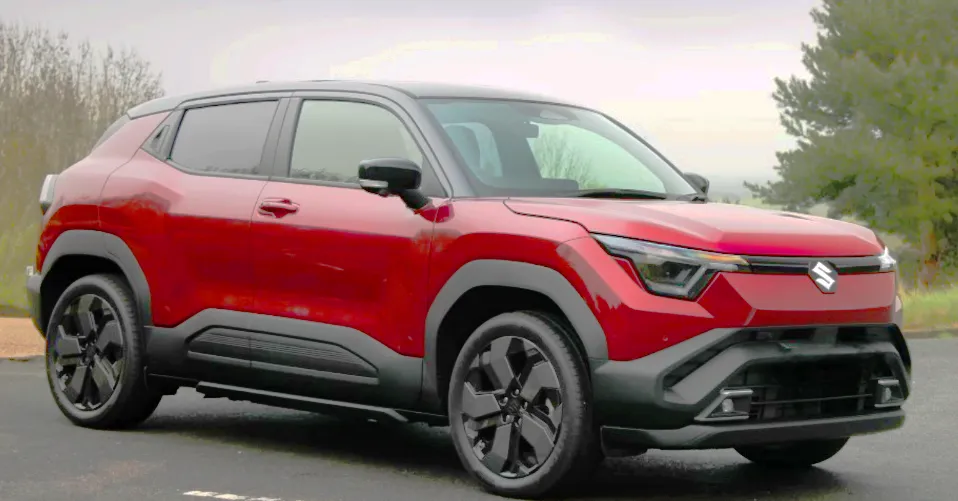
Approaching the e-Vitara, you notice Suzuki did not go full “sci-fi concept.” The lines are clean, assertive, and very Suzuki. The designers have taken cues from the classic Vitara silhouette-a slightly raised beltline, squared shoulders, and short overhangs-but refined everything with electric intent.
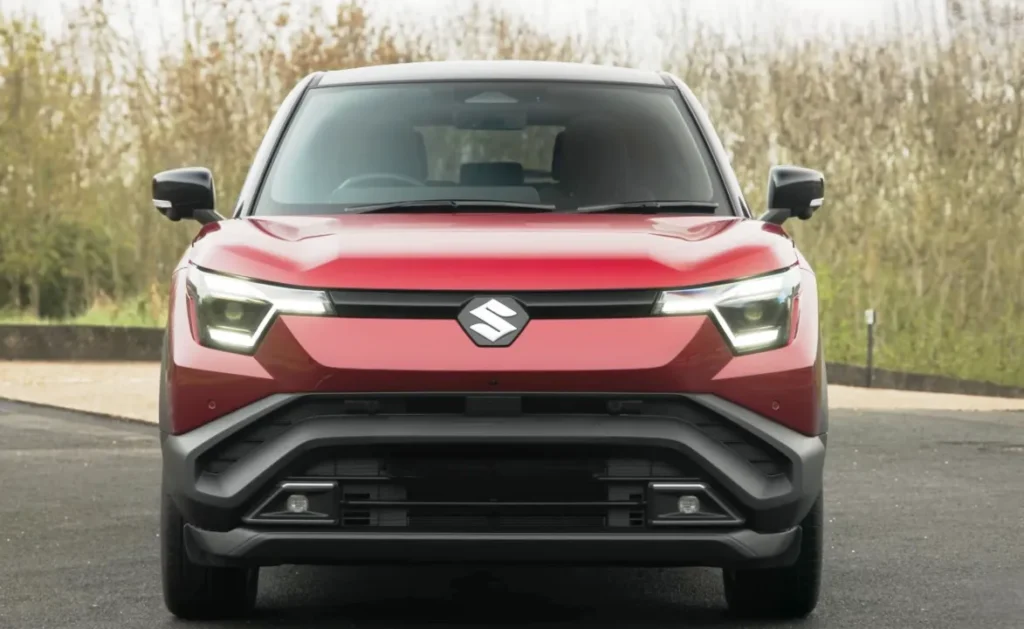
Up front, a closed grille hints at aerodynamic efficiency; LED light bars running across its width give it a futuristic stance, while the charging port hides neatly under the badge — subtle, not showy.
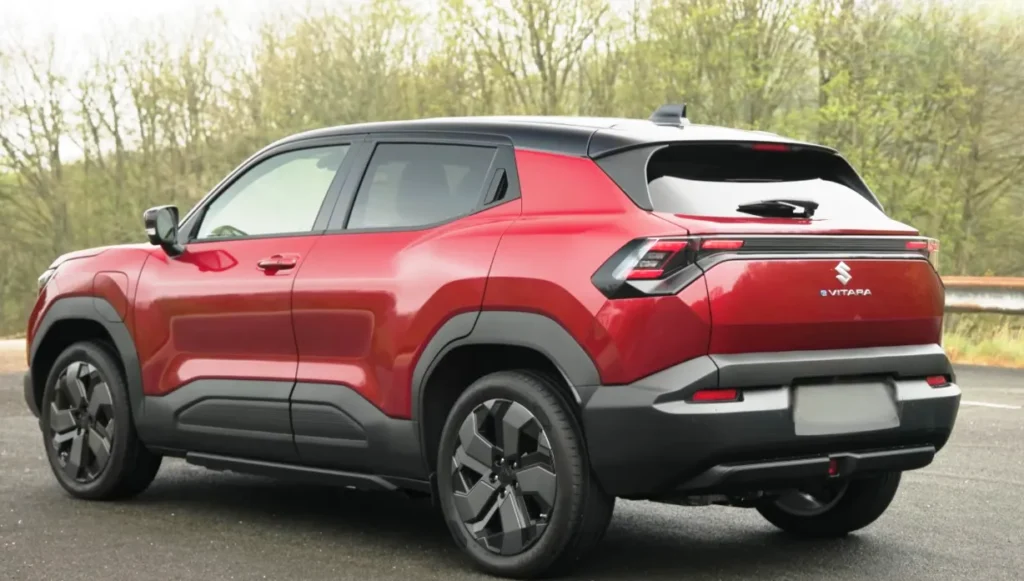
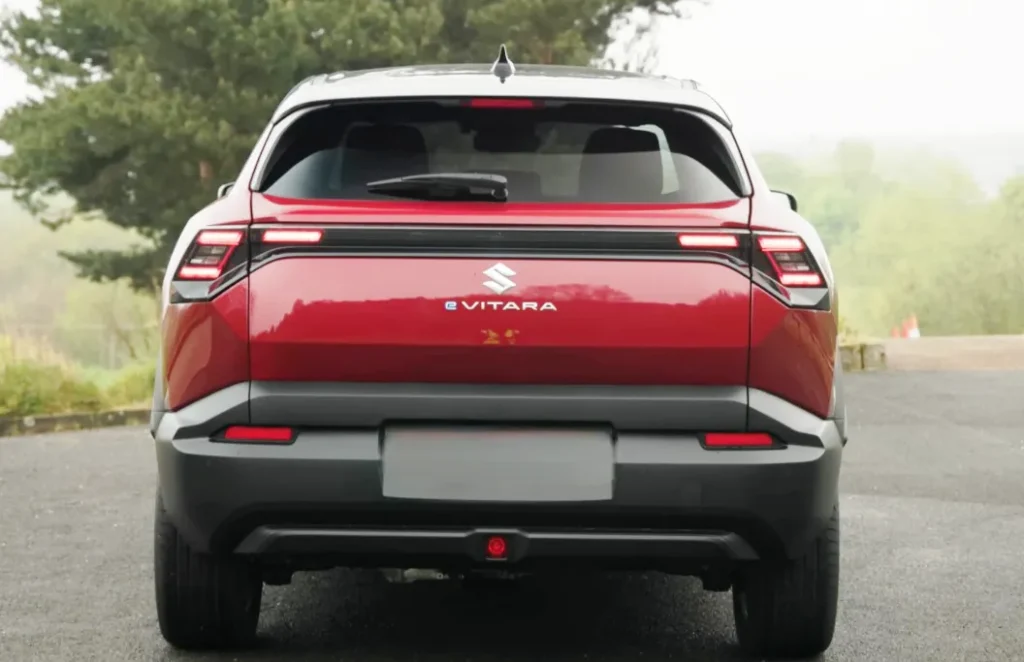
From the back, it feels compact yet muscular with sharp tail lamps and a tidy spoiler lip. For a change, there’s no attempt to shout “EV!”, the e-Vitara simply looks confident, the way a well-cut jacket looks sharp without needing sequins.
Interior: Suzuki Grows Up
Step inside, and the transformation continues.
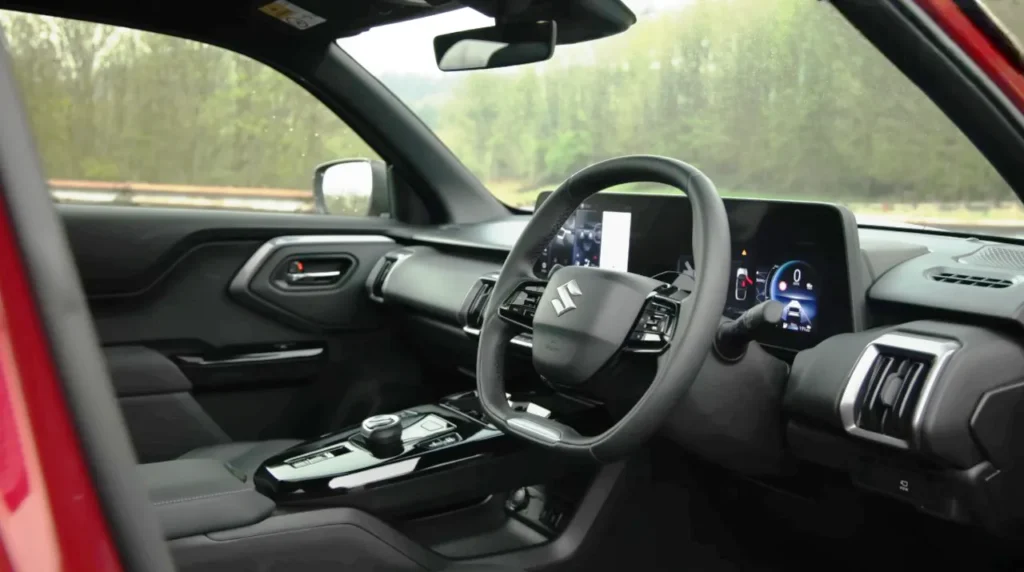
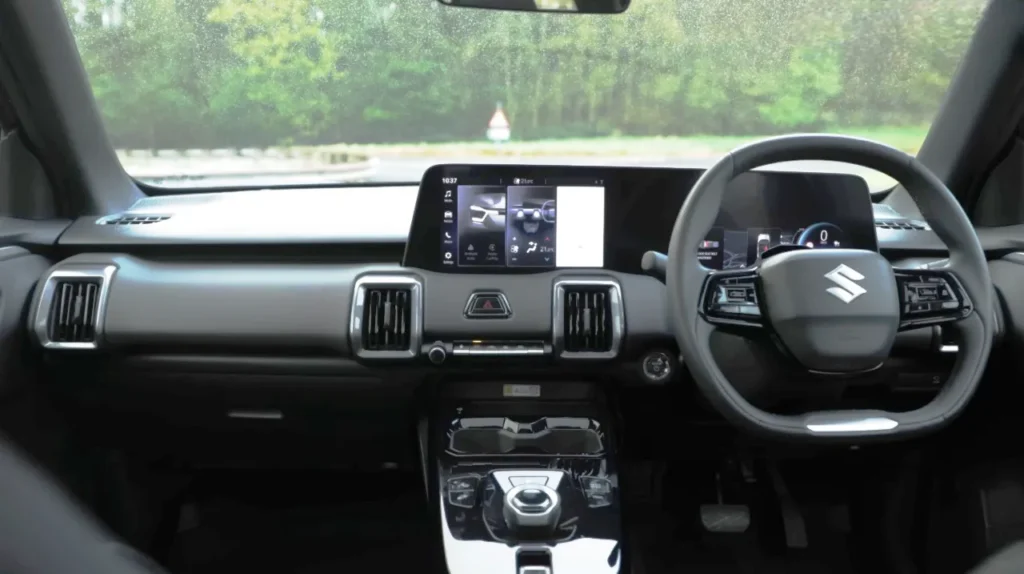
Suzuki has clearly decided to graduate from budget-friendly plastics to something far more refined. The dashboard flows like a single sculpted piece, layered with soft-touch materials, matte finishes, and precise switchgear. It’s as if Suzuki has peered in at the interiors of its European rivals, taken careful notes-then quietly done it their own way.
Set into the centre console is an impressive 10.25-inch touchscreen, appearing to float much like a glass tablet, with a Digital Instrument Cluster that changes and morphs with drive mode. Most importantly, the Infotainment system feels responsive, modern, and mercifully lag-free – a significant leap ahead for the brand.
Seats are firm but comfortable, with supportive bolstering that hints at long-distance intent. The rear floor is flat, giving generous legroom, and the panoramic sunroof floods the cabin with light.
Every switch and knob feels thought-out, tactile, and deliberate. Even the door thud-that simple, satisfying clunk-speaks of a new level of build precision.
It’s not luxury, but it’s solid, mature, and quietly premium-very “Suzuki grown up.”
Image source web
Performance: Tranquil Power, Honest Soul
Under the sheet metal sits Suzuki’s new HEARTECT-e platform, purpose-built for electric vehicles. The e-Vitara comes with two battery options: a 49 kWh pack that’s ideal for daily commuters and a larger 61 kWh version best for long-distance explorers.
In the larger configuration, power sits at around 138 bhp, and instant torque means city acceleration feels eager and effortless. The 0–100 km/h sprint takes about 8.5 seconds, but that number doesn’t tell the story. The e-Vitara isn’t about speed; it’s about serenity.
It glides. It whispers. It feels planted in corners thanks to the low centre of gravity, and the steering – while light – communicates enough to keep you engaged.
The All Grip e-4 system brings back Suzuki’s off-road confidence, apportioning torque between wheels to maintain traction when the tarmac ends. You won’t be rock-crawling the Alps, but snow, mud, or gravel? No problem.
Range? Suzuki’s target WLTP figures hover around 400-450 km for the 61 kWh pack, depending on driving mode and terrain. Real-world results will likely sit just under 400 km — solid for this segment.
Charging speeds reach a maximum of 100 kW DC, which brings it from 10 % to 80 % in roughly 35 minutes, while the 11 kW AC charging covers the overnight routine.
It’s a simple formula: no drama, no gimmicks — just drive, charge, repeat.
Safety IN: The Armor Nobody Sees
Suzuki knows that European customers take safety seriously, and the e-Vitara comes prepared.
It packs the full Suzuki Safety Support 2.0 suite, which includes:
Adaptive Cruise Control with Stop & Go
Lane Keep and Departure Prevention
Blind-Spot Detection
Traffic Sign Recognition
Driver Attention Alert
360-degree camera with reverse guidance
The HEARTECT-e chassis helps to better handle impact forces through the use of ultra-high-tensile steel, and Suzuki is gunning for a 5-star Euro NCAP rating.
For a company once known for bare-bones simplicity, this level of tech is almost startling-in the best possible way.
Image source web
Capability: Still an SUV at Heart
Yes, it’s electric. Yes, it’s quiet. But at heart, the e-Vitara remains an SUV which relishes a challenge.
With 190 mm of ground clearance, short overhangs, and that clever AllGrip e-4 traction system, the e-Vitara will happily take you down an unpaved countryside road or through a slushy winter lane.
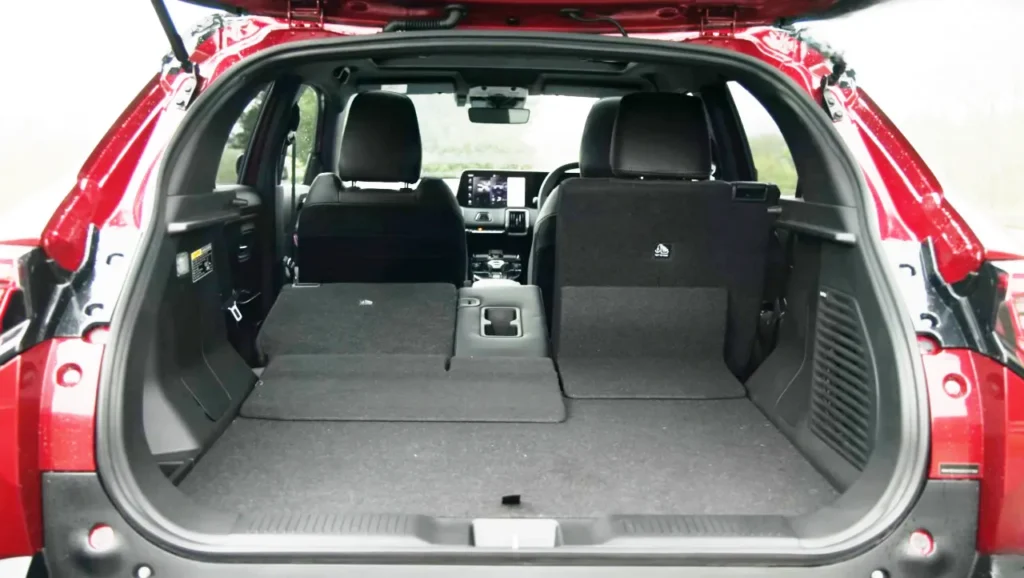
The boot space is still very practical, at about 380 litres, extending to more than 1,000 litres with the seats folded flat. The battery pack fits nicely under the floor, so there’s no hump or awkward step.
It’s a car designed not to impress the valet but to satisfy the traveller — the weekend wanderer for whom confidence means much more than chrome.
Image source web
Pricing and Market Outlook
Suzuki is positioning the e-Vitara rather aggressively. European prices are expected to start at around €29,000 for the base 49 kWh 2WD and reach €37,000 for the 61 kWh AWD version.
Deliveries will start in early 2026 across Europe, including markets such as Germany, France, Italy, Spain, and the UK, with the first export batches from Suzuki’s Hansalpur plant in Gujarat, India.
This global production model keeps costs low and availability high — a smart strategy that could see Suzuki carve out a niche below the Hyundai Kona EV and Peugeot e-2008 while outlasting the Chinese newcomers on reliability.
Driving the e-Vitara is a bit like bumping into an old friend who now wears designer clothes and listens to podcasts about sustainability.
It’s still recognizably Suzuki — practical, slightly quirky, and always dependable — but now it’s whisper-quiet, leaving behind a faint glow of smug eco-satisfaction.
No drama or ego, just efficiency with a smile.
Image source web
The Verdict
The 2025 Suzuki e-Vitara doesn’t try to rewrite the electric-SUV rulebook. Instead, it brings one thing that’s been missing from the EV conversation: honesty.
It’s not the fastest, nor the flashiest. Still, it is the kind of car that you can live with every day, drive anywhere, and trust for years. It feels at once familiar yet futuristic-the very definition of a modern classic in the making.
If you want an EV that behaves like a real car, not a rolling gadget, the e-Vitara deserves a spot on your shortlist. It’s Suzuki’s comeback moment-one silent revolution at a time.
Image source web
FAQ
Q1: Is the Suzuki e-Vitara a full EV or hybrid?
It’s Suzuki’s very first all-electric SUV, based on a dedicated EV platform – rather than being a hybrid conversion.
Q2: What’s the real-world range?
With this 61-kWh battery, you should expect around 380–400 km under normal driving conditions in Europe.
Q3: Does it have all-wheel drive?
Yes, the 61kWh variant gets Suzuki’s AllGrip e-4 system for superior grip on unsealed or slippery surfaces.
Q4: Where is it to be built?
Production is based at Maruti Suzuki’s Hansalpur plant in India, with exports to more than 100 countries.
Q5: The Hyundai Kona EV or MG ZS EV-which one is better?
Indeed, the e-Vitara offers similar range, stronger build quality, and more authentic SUV feel than the Korean offerings, for a slightly lower price.