Last Updated on 15/10/2026 by Raj
Honda City Facelift : A New Vibe
The world may be obsessed with SUVs, but the sedans are not ready to give up yet. Honda City which built its reputation on refinement, reliability and effortless drivability makes a comeback with refreshed sporty design and more technology. So can 2026 Honda make an impact on the SUV dominated market? Let’s find out.
Introduction : Honda City
The Honda City is the longest continuously running name among cars in the world. India it really defined the segment. In 1990s the Honda City changed Indians mindset of what a mid-size sedan could be. It combined Japanese engineering, reliability and premium comfort with an engaging driving experience into one package. Back then owning a Honda City meant something more than just a car. For Indians it was a symbol of success and pride.
From the first generation Honda gives its buyers engineering reliability with refinement, performance and comfort, and the Honda City has spent decades building that reputation. That’s the reason for the longest time Honda City became the default choice in the mid-size sedan segment. The brand has a long legacy, and it continues to deliver that trust. Many generations of the City give us some of the best cars. Like the iconic VTEC models of the early 2000s or the sharp-handeling third-generation car that became a benchmark in its class. But now the auto world has changed and SUVs dominate the roads.
Compact and medium crossovers have become the first choice, and sedans sales are shrinking on the market. But somehow Honda City survived and we got the 5th gen city in 2020 and a hybrid version after 2 years, so it indicates that Honda invested in it. In 2026 Honda gives its iconic sedan a major update. This is second mid lifecycle update of the fifth generation City. But the overall market share of sedans are down and limited in numbers. So does it have what it takes to become relevant on the market and bring back the glory of the sedans?
Design:
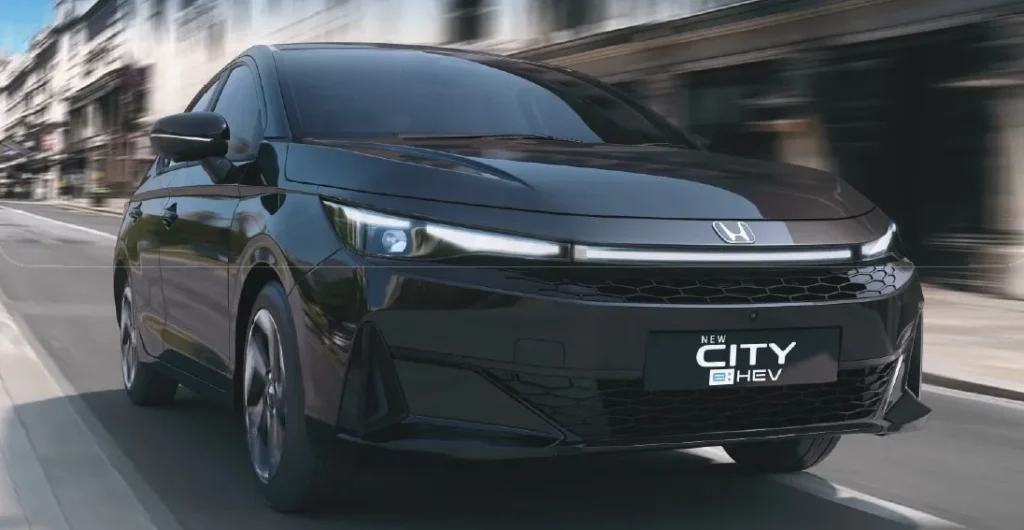
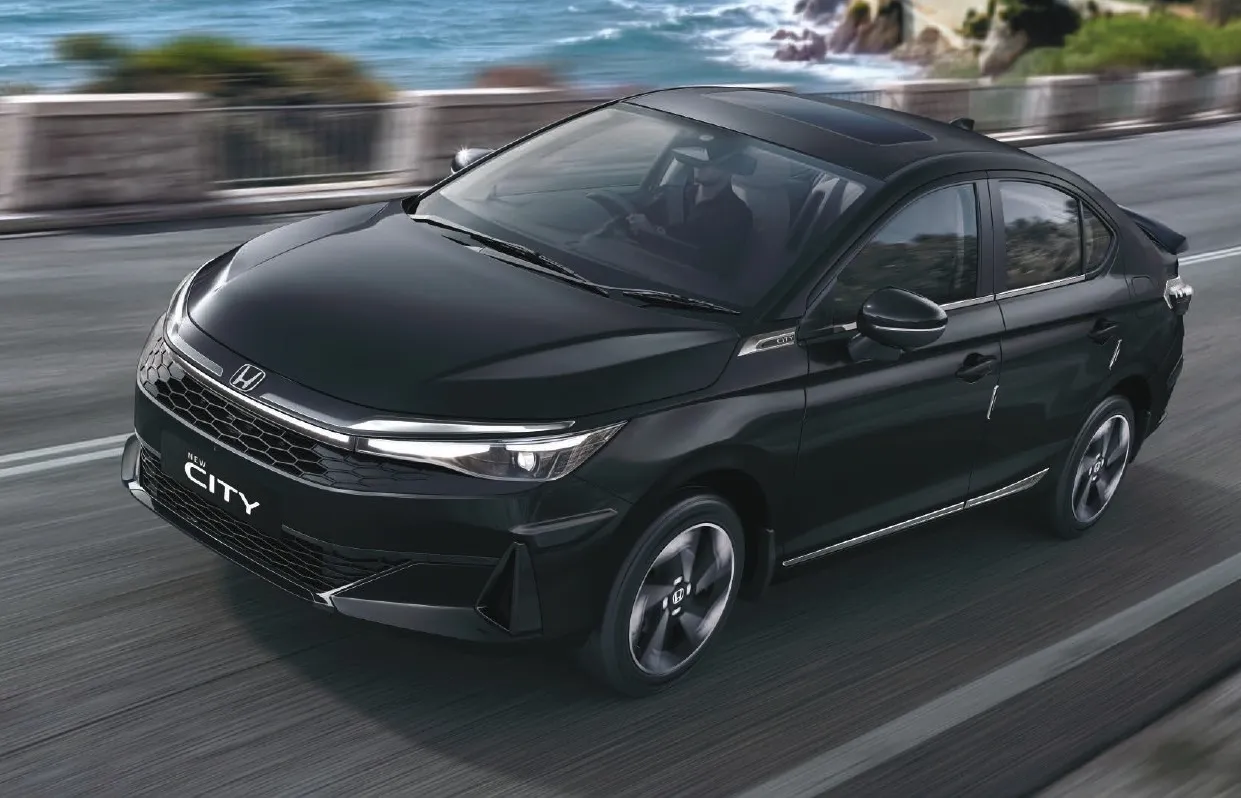
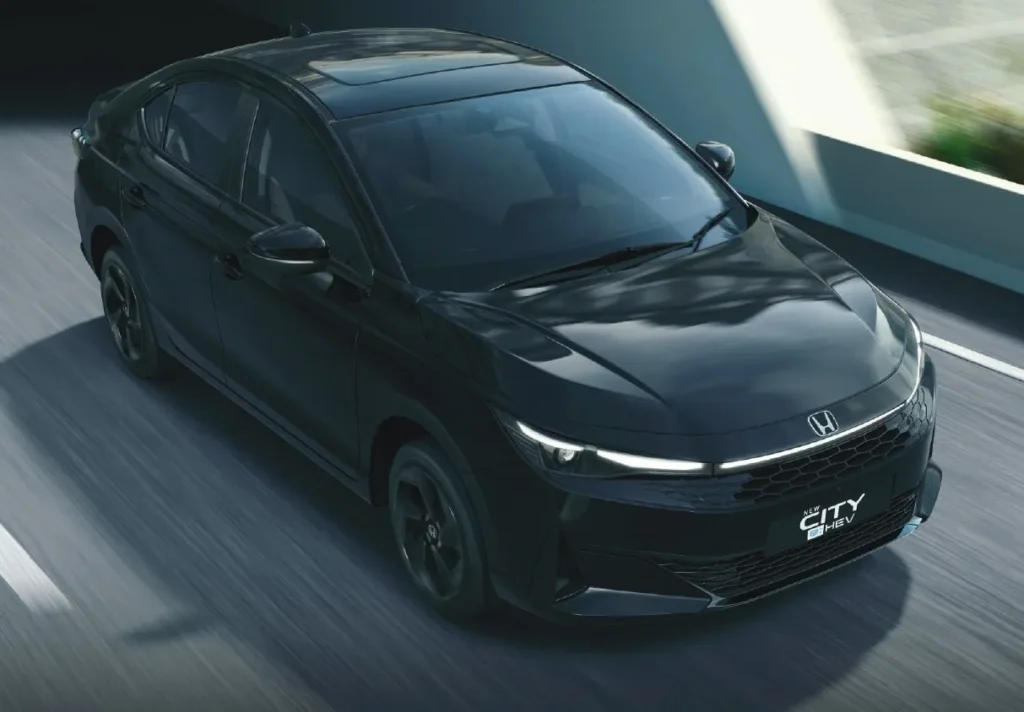
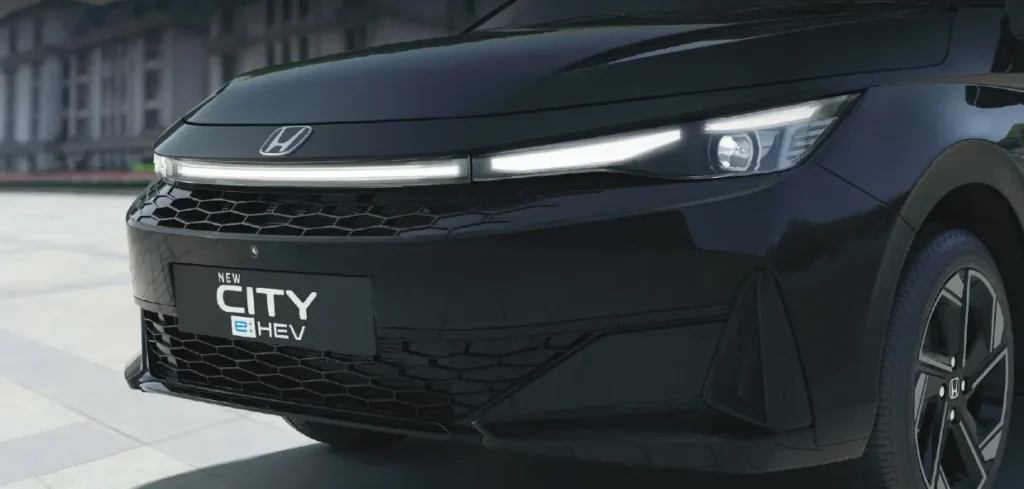
This is the 2nd facelift for this generation of the Honda City, previous was rollout an update in 2023. Like earlier, there are no drastic design changes, but this time Honda has managed to give the Honda City a fresh and sleek look with a much sportier front end. The new face design is now in line with Honda’s signature global designs which look sleek and suit the car. Honda has given the City a more contemporary face rather than angular and cut with a new redesigned grille. It has honeycomb detailing and revised LED lighting setup.
The grille design is new and features a honeycomb-pattern for better airflow, while a new 2D Honda logo sits above it like all Honda models. The new 2-piece DRL lamp signature gives the sedan a sharper look, while the front bumper with a larger air intake adds a touch of sportiness. The sleeker Blade Eye Signature LED projector headlights are connected now by a light bar on higher models, and it wraps the thick chrome band in the front grille.
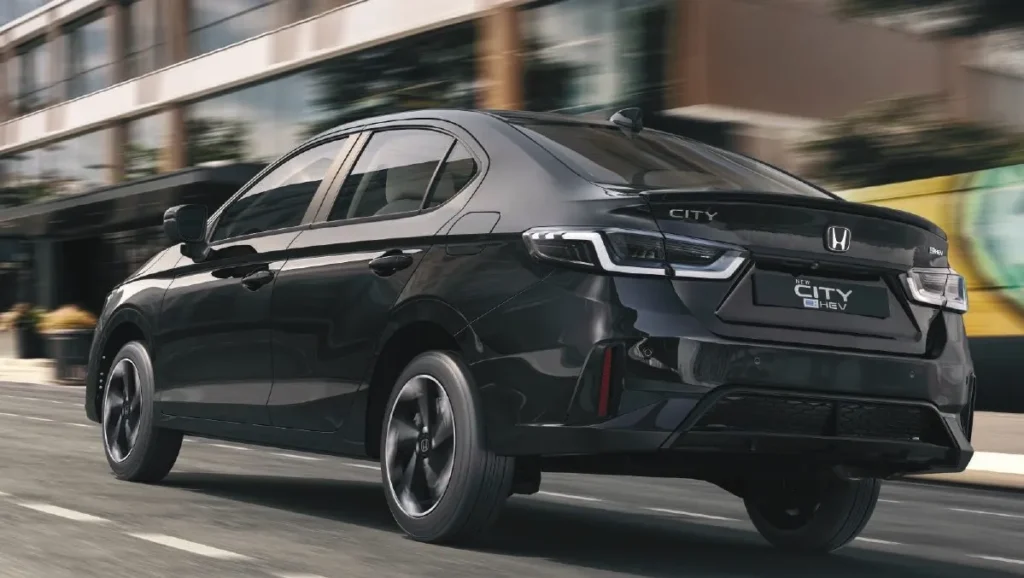
Also new bumper features functional air curtains on the outer edges helping improve aerodynamic efficiency while adding style. At the rear, changes are minimum and very similar to the outgoing car. The taillamp design remains the same, with clear-lens units and with a smoked-out effect. Honda has revised the bumper design with a larger diffuser-style element and a spoiler for sporty looks and a honeycomb grille in the center. The Honda City was the longest car in its segment and has now even longer by 11 mm measuring 4,594 mm in length.
On the side, changes are very minimal. The silhouette remains unchanged and it looks nice, and by the way Honda city continues to be one of the more elegant sedans on sale today. There are some structural changes but its very less. Only the side sills and underbody have been reinforced for added safety but this has added 20 kg to the kerb weight. Overall build quality is very good and similar to the outgoing car. The ground clearance is remain low and the front chin is long and it will scrape sometimes over tall speed breakers.
But the Honda City also gets camera based ADAS system. It’s called Honda Sensing, and it’s packed with features like adaptive cruise control, low-speed follow, lane keep assist, auto high beam, and a collision mitigation braking system. Honda has also introduced new 16-inch dual-tone alloy wheels. They look tiny, and the rivals with larger wheels certainly have more advantage. It still sits on the thin 185/55 R16 tyres, and only the hybrid variants get disc brakes at the rear wheel. The ORVMs get integrated turn indicators with the side cameras for the 360-degree view. The new Crystal Black Pearl shade has also been introduced for the first time and it looks great in the city.
Interior : Honda City
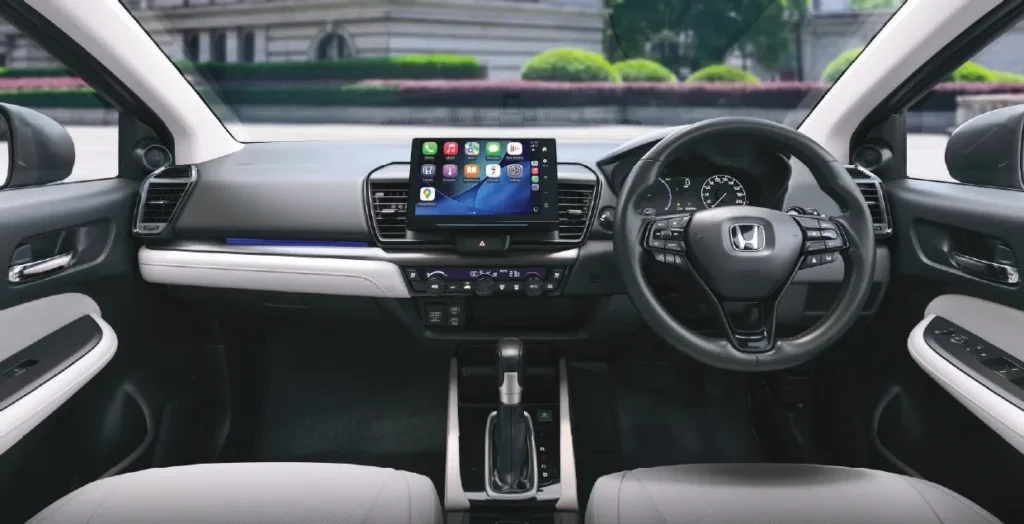
The updates on the inside are more meaningful, Honda has kept the overall dashboard design of the outgoing car but done some minor tweaks for fresh look. It has a two-tone ivory and black theme for the dashboard with a clean and symmetrical line. Fit and finish are very well like other models, and there are no ill-fitted pieces anywhere in the cabin. There are a lot of hard plastics like previous gen models. Honda should have some soft-touch plastics on the dashboard for premium feel and justify the price.
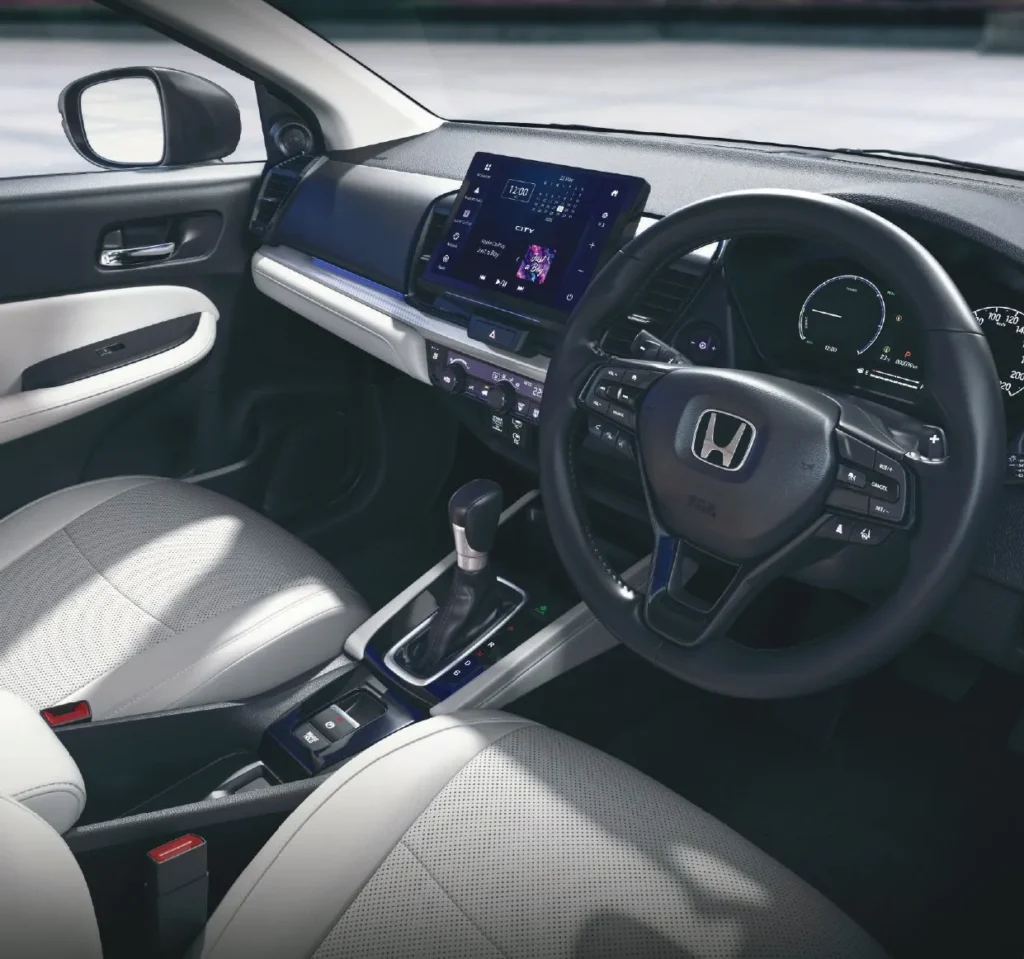
The dashboard now has a silver, textured trim piece instead of the faux carbon-fibre like element like earlier. The steering wheel is chunky and wrapped in leather and feels good to hold and also it is adjustable in height and reach. The left stalk has a button to activate the 360-degree view camera with controls, and right-hand stalk for lane watch camera button. The new addition to the Honda City’s feature is this bigger 10.1-inch touchscreen infotainment with wireless Android Auto & Apple CarPlay connectivity with few touch-based shortcuts.
You can increase or decrease the volume with the touchscreen by sliding up or down. You can slide sideways to change the song. The layout is basic, like previous car but there is no lag, and the touchscreen feels modern and up-to date. Instrument cluster designs remain the same and offers a good balance of digital and analog displays. On the right an analog speedo, while on the left a digital screen with multiple display modes with vehicle information. Now many manufacturers are moving almost everything to touchscreens but Honda has retained physical buttons and rotary dials for climate controls, and it feels good and tactile.
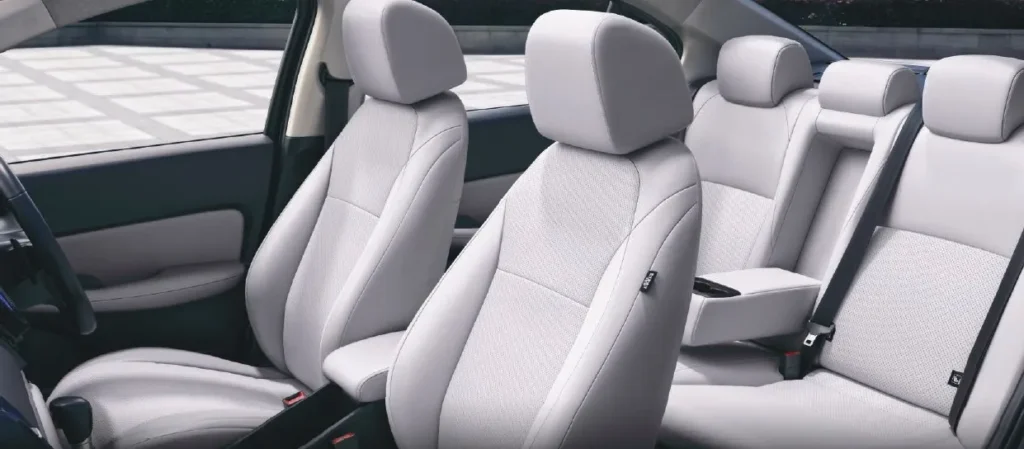
The AC vents are now all black, and the engine start-stop button has been carried this time. The cabin gets a blue ambient lighting all along. The front seat design is all new, with a bit more support and extended the seat base, and finally they get ventilation. But missed the electrical adjustment. You got a wireless charging pad and a 12V power outlet along with a Type-A and a Type-C USB port at front.
There’s also a small open storage area for the phone, and another open storage area with the cupholders. Rear seats are comfortable, like always, one of the City’s strongest areas. Space is plenty, knee room is excellent, and the seating position is comfortable and and the seats offer good support. Also gets AC vents in rear position, and USB Type-C charging ports and armrest at centre. The cabin feels totally assembled and built to last, and the material quality is generally good.
Key Features and Safety:
There are three main additions in the new Honda City. It now has ventilated front seats, a 360-degree parking camera, but the resolution and graphics are simply too low. There’s the new, free-standing 10.1-inch touchscreen on the dash. It’s angled bit sharply so it picks up reflections too easily, but most of the information is clear during the day. The user interface is basic in both design and functionality but clearly works well.
Other feature set remains the same, an 8-speaker sound system, all round ambient lighting, wireless Apple CarPlay and Android Auto, wireless phone charging, connected car tech, a sunroof and an electronic parking brake. The new 360-degree camera feature itself is a big plus in today’s market, but the image quality is not up to the mark. The City’s safety pack includes the lane-watch, hill-start assist, 6 airbags and Honda Sensing Level 2 ADAS suite. With lane-keep assist, adaptive cruise control, collision avoidance and auto emergency braking.
Highlight:
Honda SENSING Intelligent ADADS
Collision Mitigation Braking System
Adaptive Cruise Control
Lane keeping assist
Road Departure Mitigation System
Auto High Beam
Hybrid System:
Honda City uses the same tried and tested hybrid system called the e:HEV. “e:” is for the branding for Honda’s hybrid and electric technologies and HEV stands for Hybrid Electric Vehicle and the system makes about 125 BHP and 253 Nm peak torque. Honda City Hybrid used two electric motors. One works as a generator and it’s connected with the engine, and the 2nd one works as a traction motor powers the wheels. So there is no real direct connection to the wheels with the internal combustion engine.
With this type of setup, Honda has some way to minimize the use of the transmission for better efficiency. The system mainly operates like a series-hybrid system but switches to a series-and-parallel configuration and the wheels are mainly driven by the traction motor. The motor gets power from the battery pack in the boot and also the generator connected to the IC engine.
If the battery is drained or more power is required, the petrol engine covers the gap by charging the battery or supplying direct power to the traction motor via the generator motor. The petrol engine is the same as previous 1,498 cc i-VTEC unit. But now it runs on the Atkinson cycle making of 99 BHP. The Lithium-ion battery pack in the boot is a high-voltage 172.8V unit and the whole system has three modes of operation.
EV mode:
EV mode is available at slower speeds with light throttle inputs when the battery is fully charged. This is pure electric mode so the IC engine does not run. The traction motor drives the wheels using the battery pack only. The Honda City remains in EV mode up to 40 km/h, unless the battery level is low or higher throttle input.
Hybrid mode :
Honda City operates in this mode mainly. At lower speeds, when the battery level is low, the car will remain in this mode. Above 40 km/h, the car will be in this mode most of the time and above 120 km/h, it is in hybrid mode only as a default function. In this mode the IC engine is running along with the electric motor which is connected with the engine. The IC engine will only come starts at idling rpm to top up the battery so that the traction motor can continue to drive the vehicle, or when vehicle needs greater acceleration or high speed. So the IC engine will drive the generator motor to provide more power to the traction motor and also charge the batteries. Also, the IC engine is still not driving the wheels mechanically, only making electricity.
Engine mode:
This mode works somewhere around 80 km/h to 120 km/h. So when the speed is optimal for the engine to drive the wheels, this mode kicks in which is the most efficient condition for the petrol engine to give the power directly with minimum effort. In this mode, the clutch is engaged connecting the engine to the wheels in a single gear ratio, which is similar to a final gear ratio. So in this mode IC engine is now mechanically driving the wheels.
While the system architecture is bit complex, but it works very seamless. Unfortunately there is no sport or manual mode to override the system. The only option is use the paddles behind the steering wheel to control the regen braking. So it don’t have anything to do with gears, because there is no gearbox. There are three levels of setting of the left paddle increases the level of deceleration, and the right paddle reduces it. So some times You don’t need to use the brake pedal for slowing down. Only to come to a complete halt, need to press the brake pedal, and electric servo braking unit regenerates energy when the pedal is pressed.
Driving:
The engine and the system immediately stand out for its refinement and smoothness. Compared to other hybrid systems used by its some brands, only used a three-cylinder engine, but in the Honda City’s four-cylinder setup feels much smoother and more balanced. Transitions between electric and petrol power are seamless even unnoticeable. The vehicle spends a surprising amount of time operating on pure EV mode, particularly in city traffic. Beyond efficiency, the Honda City is a good daily driver car for anyone. The steering is light and responsive for city use while give sufficient hold at highway speeds.
The driving position is very comfortable, and all controls are well under reach. Ride quality one of the city’s biggest strengths as always. Earlier generations offered more agility and responsiveness. The current car has offers more comfort. There is still a good amount of precision when changing direction, and the chassis remains predictable and grounded. The e-CVT transmission is good and works in a smooth and relaxed manner, making the City an effortless companion in traffic.
When pushed hard and the engine becomes more noticeable, that is more of a hybrid focused on efficiency and refinement. Out on the highway, the City Hybrid is very composed and inspiring to drive. Even at triple digit mark, the sedan never feels unbalanced or struggling for power, and the car maintains speed comfortably. Once speeds climb, the engine becomes considerably more noticeable inside the cabin. Importantly the engine is not struggling for power and the performance remains strong and the Honda City continues stable at this speed without hesitation.
Mileage and Efficiency:Honda City
Honda claims a mileage of 27.26 k/l for the hybrid. The City 1.5 petrol has a claimed mileage of 17.77 k/l with the 6-speed manual gearbox and 17.97 k/l for the CVT automatic. The way the system operates, achieving this type of real-world fuel economy should not be difficult.
Ride Comfort:
The dynamics of the hybrid and non hybrid are very different. Due to the fact that the hybrid is 171 kg more than the petrol’s 1,123 kg and weight of 1,294 kg, makes some difference. This extra weight is came from at the front with the electric motors and at the rear with the battery pack in the boot and another motor connected with the engine.
Also, compared to the older model, the new Honda City gets reinforcements on the side and underbody to meet the new safety norms for side-impact and crash protection. This has added another 20 kg of extra weight. But the ride comfort is remain very comfortable at any speed. Only the big potholes and big speed breakers are noticeable inside the cabin but not very much. The suspension is bit on the softer side, giving it a smooth ride.
The Honda City is a pleasure to drive in city roads and even on highways. It doesn’t float at all and manages to stay flat and stable. The City hybrid feels more planted with very less bounciness due to the added weight. Handling is also very decent and predictable and it held its line well. In decent speed through the corners, it holds very well without losing composure. The linear power delivery makes direction changes effortless with minimum body roll.
Price: Honda City
Honda has launched the hybrid version of the City with the regular non hybrid ICE version. This time around, there are only 4 variants: SV, V, ZX, and ZX+. The prices for the 1.5-litre NA engine with 6-speed MT start at Rs. 12 lakh Ex Showroom, for the base SV variant and go up to Rs. 16.15 lakh Ex Showroom for the top ZX+ variant. The Honda City Hybrid version is available only in top-end ZX+ variant at an ex-showroom price of Rs. 21 lakh.
Pros and Cons:
Pros:
Reliable 1.5L naturally-aspirated petrol is rev-happy unit is smooth and refined.
The seamless hybrid system give excellent fuel economy and the system is much better then rivels.
Spacious and premium feeling cabin is very comfortable.
Very good ride qulity any driving condition.
Loaded with safety tech like ESP, 6 airbags, 360-degree camera, ADAS and a lane watch camera.
Lower emission and better efficiency in urban areas offered by the hybrid system.
New Feature Upgrade.
Cons:
Rivels offer more powerful turbo-petrol engines.
Hard plastic on the cabin.
The hybrid is bit costly for a mid-size sedan making only 125 BHP on tap.
Boot space on the hybrid is low the battery pack and spare tyre.
Still being offered with low profile tyres.
Missing features like powered seats, premium audio system , adjustable rear headrests, rear disc brakes on non-hybrid variants.
Low ground clearance.
Verdict:
The Honda City facelift is not revolutionary, it’s special. Honda is not chasing huge screens, touch-heavy controls and unnecessary things. Instead of Honda, they have chosen the build qualities that have sustained the Honda City for more than 3 decades. They stayed true to the fundamentals that matter most comfort, refinement, practicality and efficiency are the first choice.
Even after all these years, it is exactly what it wants to be and it did pretty well. The new styling is more suttle, the new features address more comfort, and the hybrid powertrain remains one of the shortest after options available in the segment. Yes some things could be better , like the infotainment screen could have been better in response. The 360-degree camera quality needs improvement and the absence of electronic powered driver’s seat.
But these shortcomings are not a big deal to compare with the Honda City’s core strengths comfort, refinement, efficiency and reliability. The City Hybrid certainly is expensive when compared. In fact, the cost put it in the range of larger and more feature-loaded SUVs. Yet, the Honda City is always a different car. Anyone who still loves the charm of a sedan, spend most of their time in the city area, and loves to drive on long highway and who value comfort, refinement and fuel efficiency, the 2026 Honda City Hybrid is one of the best choice.