2025 New compact SUV- Hyundai Venue and Venue N Line
The new Hyundai Venue and Hyundai Venue N Line are now here. Hyundai refresh its compact SUV after a long time. In this story-driven deep review of the 2025 Hyundai Venue we talk about design, interiors, performance, safety, and pros, cons, with our real-world verdict.
Intro: Hyundai Venue
Since 2019, the Hyundai Venue has been one of the most successful name in Hyundai’s SUV line, with over 7 lakh units sold, demolishing its rivals and a consistent position among the top three compact SUVs in India.
Venue has played a vital role in Hyundai’s SUV sales and its progressive and customer-centric brand. Loved by young working professionals who want performance, and tech, Hyundai VENUE has become preferred choice. With the all-new Hyundai Venue and Venue N Line, Hyundai rewrite the story to the next level with major update, and designed it safer, smarter, and more premium.
The new Hyundai Venue’s new body design, advanced technology, superior safety and excellent performance are setting new benchmarks. In a segment that’s extremely competitive and rapidly evolving the compact SUV segment.
The 2025 Venue now starts at Rs. 7.90 lakh , which is Rs. 59,000 less than old car, with the new design and updated feature. Ready to take on rivals like the Tata, Kia, Maruti Suzuki and Mahindra, but can Venue really set the game up, or is this simply a hyped?
HISTORY of Hyundai Venue :
About five years ago before compact SUVs became smartphones of car world. Hyundai sense the problem. Cities were packed and bumper getting higher, so people wanted decent height and space and comfort, but not something the size of a bus.
Then Hyundai introduced the Venue in India— and it quickly became a success even to this day. The Venue is, perfectly calibrated for the modern city compact, efficient, powerfull and most important easy to drive.
Hyundai VenueDESIGN:
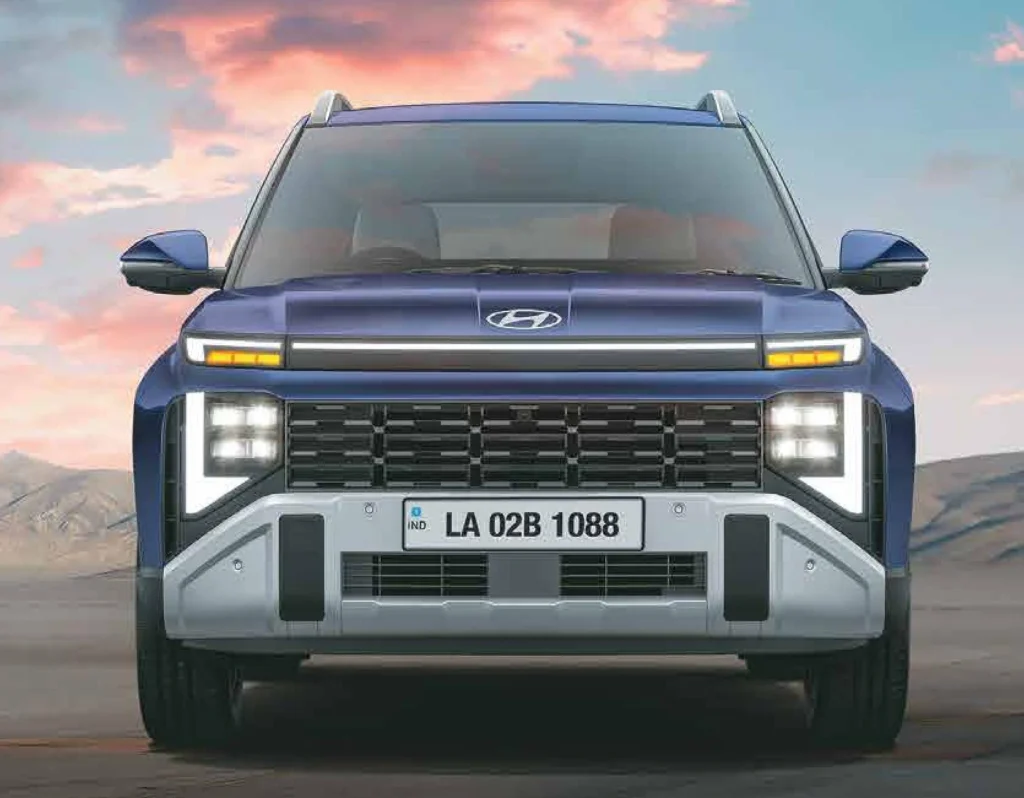
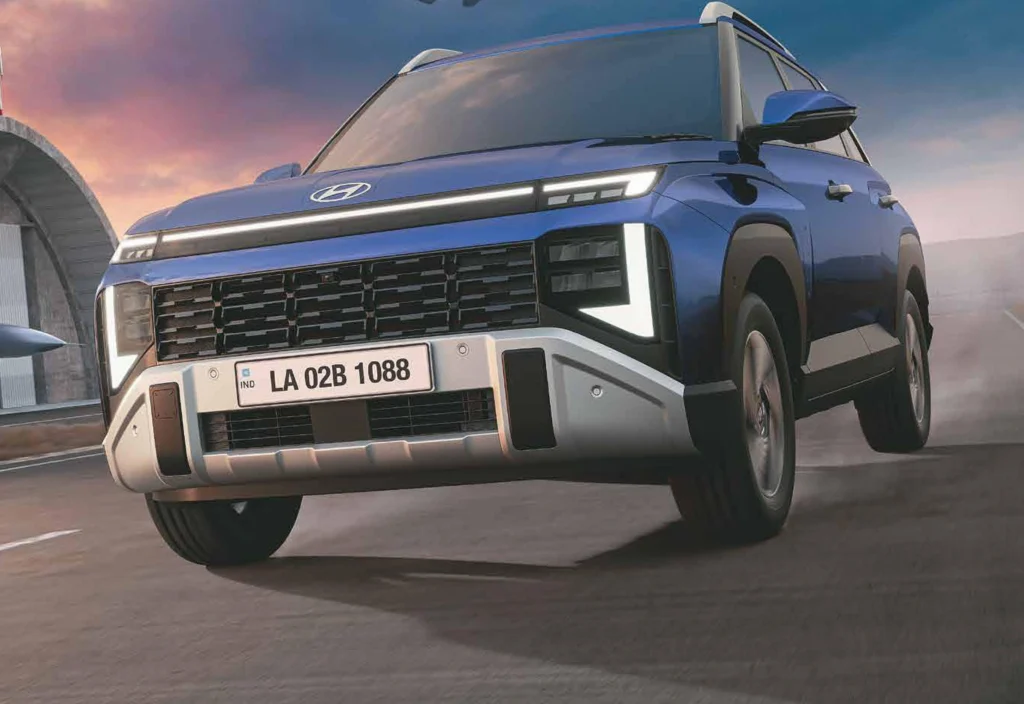
New Hyundai Venue gets a completely revamped design. Changed the previous model’s smooth, rounded lines with sharper creases and chunky wheel arches, gives more muscular look. It debuts with a completely fresh design, looks noticeably different from the older model.
Venue now sits on Hyundai’s K1 platform, replacing the older K2 base, same platform is also used by the Kia Syros and Hyundai Grand i10 Nios. This new platform’s structure is more rigid and better suited for the improve safety tech and features. Hyundai uses high-grade steel across the A- and B-pillars and also in the floor for more structural integrity.
It’s also slightly larger than before wheelbase is up by 20mm, so it’s 30mm wider,and 48mm taller, but overall length stays within the sub-4 metre bracket. Boot space, also increased to 375 liters, overall improves practicality, but some rivals offer a larger overall size and cargo area.
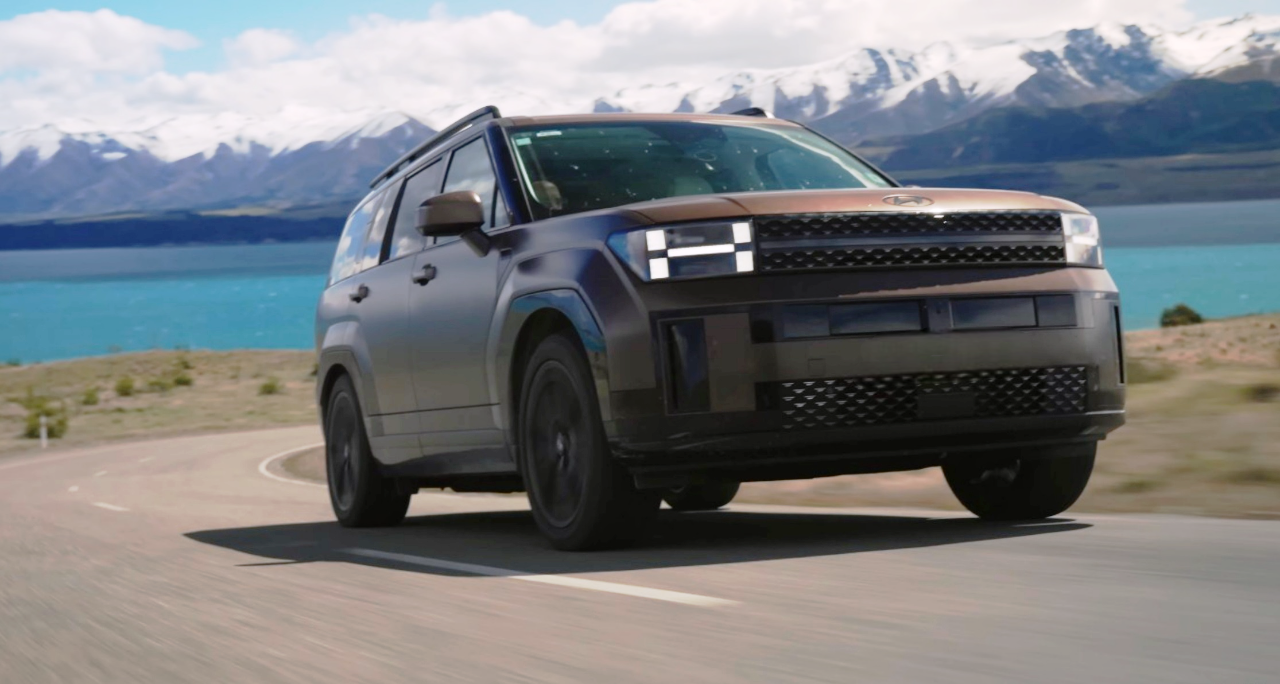
The Venue has gone through major design changes. The front of the Venue has inspired by Creta. Extra and even the Palisade now became bolder, more layered face. And with drop down LED DRLs and sleek LED headlamps to the bumper gets shorter and horizontally patterned grille, and a big silver-finished skid plate adds a tough look. The N Line gets a narrower grille and a more angular lower profile with red accents. Side profile gets sharp creases and thicker plastic cladding, stronger arch line, and a new rear-quarter glass.
The new 16-inch diamond-cut alloy wheels fill up the big arches well, but aero-inspired design resembles the wheels of typically EVs, and the N Line gets bigger 17’s and red brake calipers.
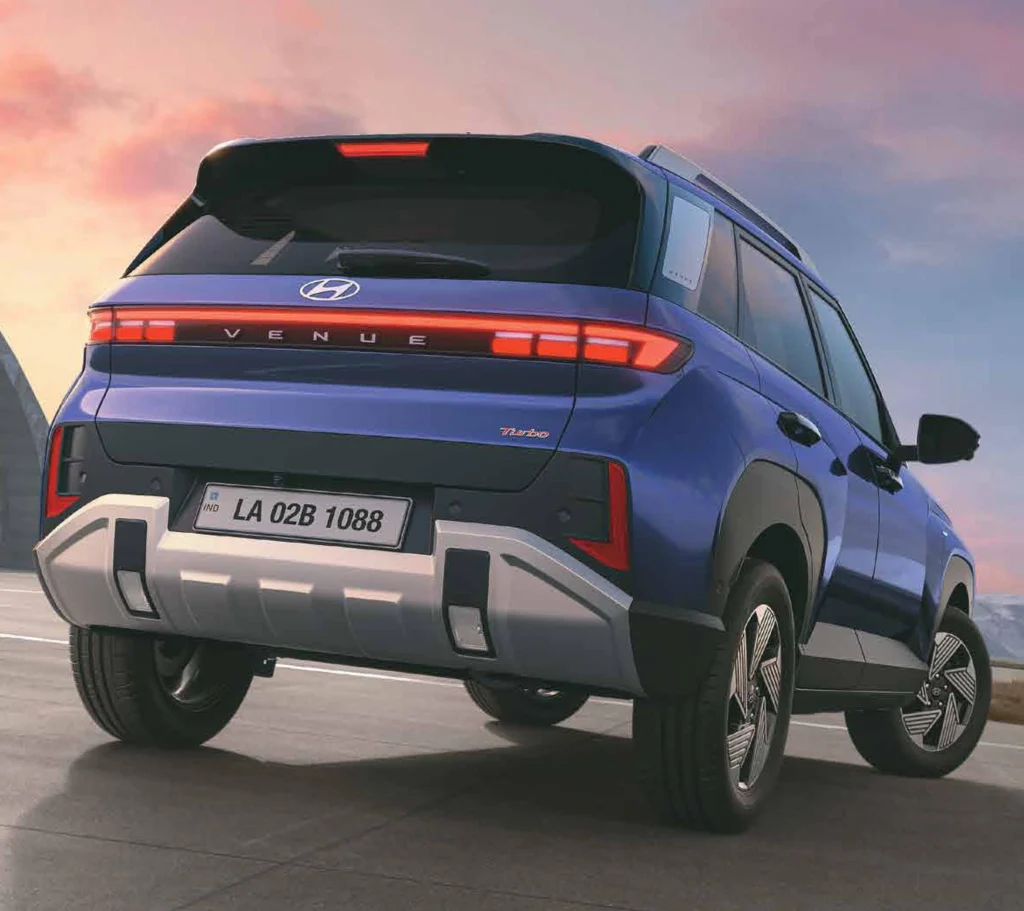
The rear design is where the Venue truly shines. Connected LED tail lamps span all width, and rear skid plate adds sporty appeal, with Venue lettering across the tailgate, new more bigger spoiler give it a more premium appearance.
N Line has a more angular rear end with dual-tip exhausts and dual-ridge spoiler. Overall, the Hyundai Venue looks better than before and feels more in line with Hyundai’s latest design and it does a good job of standing out in a overcrowded segment.
Key highlights:
New model 48 mm taller and 30 mm wider than the old model.
Quad beam LED headlamps & Twin horn LED DRLs
Horizon LED positioning lamp with Rear horizon LED tail lamps
Bridge type roof rails, Dark chrome radiator grille, Signature C-pillar garnish
Interior :Hyundai Venue
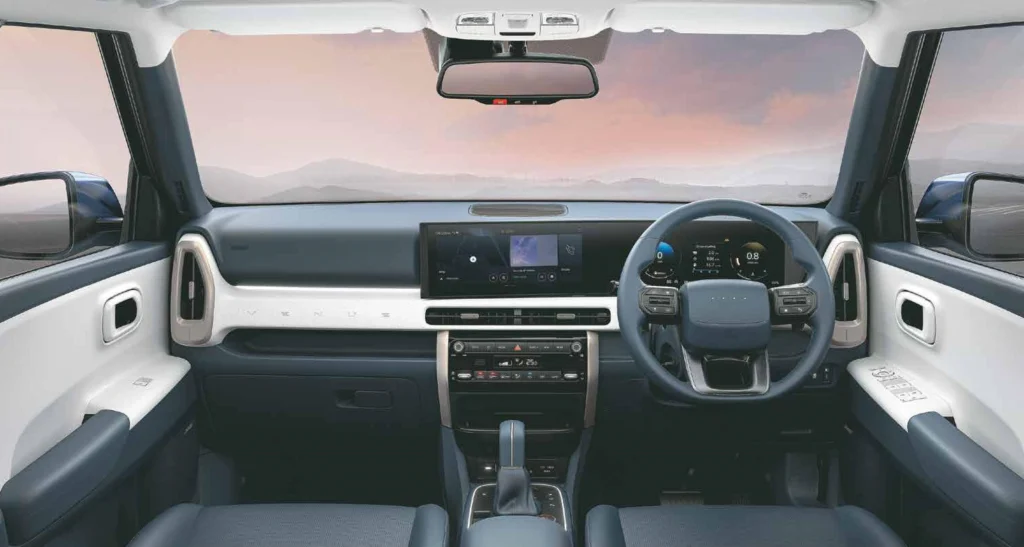
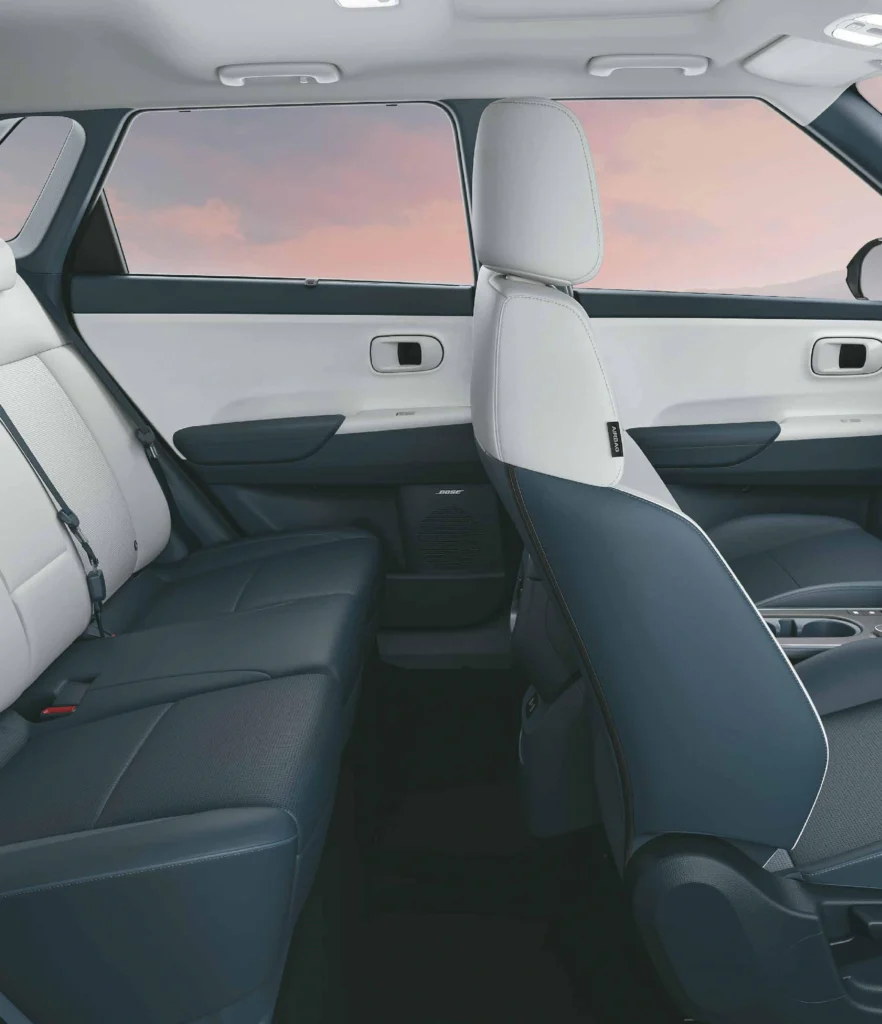
The Interiors of the new Hyundai Venue feel more tech-savvy, look modern, and upmarket. Hyundai take a big step up in new model design. The car more premium clearly paying attention to detail and usability. The dashboard is completely redesigned and now features a classy dual-tone finish with vertical AC vents. Both ends connected by a fin of white stretching across the dash blend seamlessly with the new H shape layout.
The twin curved 12.3-inch infotainment screen is integrated with digital instrument cluster. It’s larger than the Creta’s 10.25-inch units and also gets Hyundai’s latest UI, which is smoother, more intuitive,and includes some shortcuts for quick access to key functions. New Venue also equipped with premium Bose sound system which enhanced audio experience.
The D-cut steering wheel, with four dots (Morse code for H) replacing the older Hyundai logo, like the Ioniq 5 and integrated with multifunction controls.
The wheel is chunky and nicely contoured feels good to hold. The center console retains an old-school charm with physical button what Hyundai calls a coffee-table design, surrounded by a strip of ambient lighting.
It is mostly hard plastic, but it’s well finished with nice detailing. The physical buttons and knobs used also integrate certain infotainment shortcuts. Reducing clutter and making the interface easier to use on the move.
The N Line gets more sinister ambience with an all-black cabin and flashes of red. With N-specific steering wheel similar to the one in the Ioniq 5 N and N logo front and center, it even has pods for the drive and traction mode buttons on the steering.
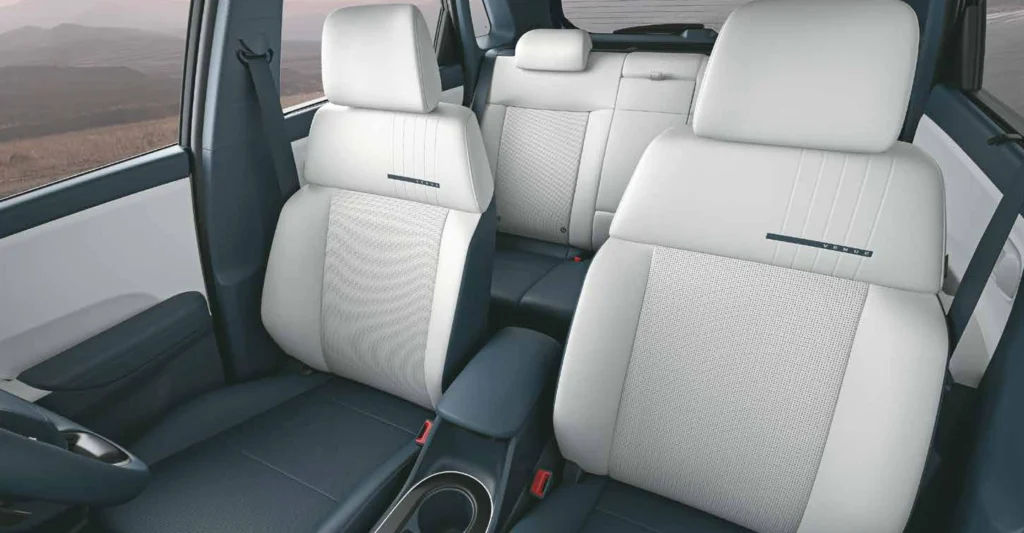
Interior volume has also increased by using new platform and get larger dimensions. The front seats are much wider and supportive than ever, with power adjustment and ventilation driver’s seat. The rear seat benefits significantly from the stretched wheelbase now has more knee room and scooped-out front seat backs. Also get more shoulder room.
The rear seats now offer two-step recline adjustment, with sun blinds and twin Type-C charging ports add more convenience for passengers. Cargo capacity has also grown from 350 to 375 liters, with 60:40 split rear seats further enhance flexibility but the front seat experience that’s the most improved.
Key Highlights:
Dual (12.3” + 12.3”) Curved Panoramic displays.
Rear window sunshade and Dual tone leather seats with premium leather armrest.
Coffee table design centre console and surround by ambient lighting.
Ambient lighting on crash pad with terrazzo-textured crash pad finish.
New D-Cut steering wheel.
Electric 4-way driver seats and 2-Step reclining rear seats with rear AC vents.
Performance:
The 2025 Hyundai Venue retains its familiar engine options including the 1.2-litre petrol, 1.0-litre turbo-petrol, and the 1.5-litre diesel with same range of transmissions before but the diesel engine now gets an automatic. It now pairs with a six-speed torque converter that is only exclusive to the Kia Sonet.
The base motor is naturally aspirated 1.2L 4-cylinder unit making 83hp and 114.7Nm of torque paired with regular 5-speed manual.
The diesel engine is a 1.5L CRDi Engine, generating 116bhp and 250 Nm of torque now can be paired with a 6-speed torque converter automatic or with the standard 6-speed manual. The 1-litre, 3-cylinder turbo-petrol with 120hp and 172Nm of torque offered with a 6-speed manual or a 7-speed dual-clutch automatic for N line.
The most enthusiastic of the lot is the turbo petrol but with hint of turbo lag initially, but post 2,000 rpm it gives strong performance. It’s relatively refined and N Line’s muffler adds a bit more fun to the experience. Both the manual and DCT are good. But the DCT has the added advantage of switchable drive modes.
While diesel with 6-speed torque converter is smooth and you can barely tell it’s a diesel under 2,000 rpm.The diesel-auto combination feels refined and gearshifts are seamless, and linear power delivery makes it an easy and relaxed cruiser.
Key Highlights:
• Kappa 1.2L MPi petrol: A dependable and smooth for everyday driving and paired with a Five-speed manual transmission.
• Kappa 1.0 L Turbo GDi petrol: A turbo petrol with fast acceleration for more powerful experience. The powertrain can be paired with a 6-speed manual transmission or advanced 7 speed DCT transmission with idle stop and go.
• U2 1.5 l CRDi Diesel: Designed for performance without any compromise, this diesel powertrain matches with a manual transmission or 6-speed torque converter automatic.
Features and Safety:
Feature-wise biggest talking point is the new dual 12.3-inch screens display – larger than the Creta and Syros. It’s not just the size though; the screen system is powered by the latest NVIDIA ccNC making its smart and responsive as a smartphone.
Its resolution is also really sharp, paired with the 360-degree camera setup that takes over the whole screen, graphics and the UI for both screens have also been redesigned with a minimalist aesthetic.
So it’s easy to use also with some customisation possiblity. Other tech includes ventilated front seats at front, a wireless charger tray, smart key with push-button start, an 8-speaker Bose audio set and a sunroof but not panoramic.
Hyundai Venue now gets Hyundai’s Smart Sense and Level 2 ADAS has a total of 16 features like forward collision avoidance, lane-keep assist and adaptive cruise control with 360-degree camera, stop-and-go functionality. And N Line gets five more, including rear cross traffic assist and blind spot assist. The Safety list is also comprehensive with six airbags, ABS, ESC, VSM and ISOFIX mounts with tyre pressure monitoring, a rear defogger and a rear camera.
Technology Highlights:
•31.24 cm (12.3”) Full digital display cluster with ccNC Navigation system, by NVIDIA.
•Bose 8 speaker system and Front row ventilated seats.
•Surround view monitor and Wireless Android Auto/Apple CarPlay.
•Voice enabled smart electric sunroof and blind Spot monitor.
•Upto 20 controllers capable of over-the-air (OTA) vehicle updates, 70 Hyundai blue link connected car features.
Key Safety features:
•More than 65 advanced safety features
•Electronic stability control, hill-start assist control and electric parking brake with auto hold
•Surround view monitor 360 camera all 4-disc brakes and 6 airbags
•Tyre pressure monitoring system and 3-point seatbelts with reminders for all seats with rollover sensor.
Capability :
Hyundai Venue is truly a well-rounded product, the low-speed ride quality has improved significantly, slightly more softly sprung than its predecessor. Hardly any of road sound passes into the cabin, making drive much more comfortable.
Damping at low speed is still not totally fine with underlying firmness when it comes across a sudden pothole or worse, a series of bumps, when it pick up the pace, the suspension continues to handle undulations well. Body roll is well-contained, though the Venue isn’t a corner carver.
The Diesel model due to its heavier weight felt slightly more composed to drive. The steering gets noticeable improvement now offers better feedback. It’s light and responsive so parking and tight manoeuvres are easy, and agility continues to impress.
Hyundai made some tweaks with suspension and steering of the N Line to make them sportier. N Line used exactly the same setup as the regular with only a slight firmness from the larger 17-inch wheels. The three driving modes, Eco, Normal, and Sport, alter throttle response and steering response, give some flexibility based on driving style.
Pricing:
Hyundai has kept the Venue accessible; all base variants remain affordable start with– from Rs. 7.89 lakh (ex-showroom). But move up and prices climb sharply.
The top-spec N Line price is Rupees 15.48 lakh.
Reaching Rupees 14.74 lakh for the turbo DCT.
And the diesel automatic Rupees 15.69 lakh.
Priciest in the segment but delivers the features to justify it.
Pros and Cons:
PROS-
Hyundai Venue Cabin looks and feels premium with quality above segment standards.
Superb features slick infotainment system and good user interface experience.
Comfortable ride, smooth engines and smooth auto combo.
Easy to drive in cities and strong safety with great value package.
CONS-
Turbo variants may cost more to maintain and top variants are pricey.
Rear seat width is ideal for two adults but not for three and no panoramic sunroof.
Not for the hyperactive performance lover because N Line mechanically same to standard version.
Final Verdict:
Hyundai Venue get loads of updates for 2025 feels like a complete new car. Now it feels more evolved than ever much mature, more sophisticated, with load of features but retaining the user-friendly. The design is edgy give it a sharper and more assertive look. While the tech-laden cabin looks and feels genuinely premium and modern.
Muchupdated ride quality and stronger structure add to its more drive appeal. So if you want compact SUV feels big and gets modern features, comfort, and everyday usability. The new Hyundai Venue can be a good choice. It might not the best in the segment, but it can fits with your daily overall lifestyle.